Olamet - Video Chat Online
- 4.1
- Rating
- 5.00M
- Installs
- Free
- Price

 Analysis by App-foxy
Olamet caught my attention because it is built around meeting strangers through live social interaction rather than scrolling through a carefully edited feed. The basic idea is simple: open a conversation, see whether the person on the other side feels interesting, and move on when the exchange has run its course. In my first week, that immediacy made the app feel more lively than ordinary social networks, especially during short breaks when I wanted conversation instead of passive browsing.
It is a free social app from Olamet, aimed at mature users and centered on online video chat. The experience is more spontaneous than a traditional messaging service, but that spontaneity is also what makes it unpredictable. I found moments of genuine entertainment alongside conversations that went nowhere. Whether it deserves a permanent place on your phone depends less on the novelty of meeting strangers and more on whether you can turn that novelty into a comfortable, repeatable habit.
How Olamet feels after the first week
The first sessions are easy to understand. I did not need to build a public profile, prepare a long introduction, or spend time learning a complicated social system. The appeal comes from the possibility that the next conversation may be more engaging than the last one. That small element of uncertainty gives Olamet a different rhythm from apps where I already know exactly what content will appear.
You May Also Like

 Blood Strike: 2.5 Anniversary
Blood Strike’s Loadouts Turn Every Drop Into a Tactical Gamble
A close look at Blood Strike’s custom loadouts: how fast access to signature weapons reshapes its battle royale rhythm, rewards preparation, and narrows the gap between fights.

 Pandora - Music & Podcasts
Pandora’s Music Is Easy to Start, but Harder to Recover
Pandora’s strength is its low-effort path from a seed to a station. Its weak spot is how much confidence it asks you to place in connection, setup, and quiet recovery.

 8 Ball Pool
 Is Built on Rivalries, Rematches, and Routine
A close look at the rivalries, rematches, shared routines, and unanswered safety questions that turn a quick pool match into a persistent mobile community.

 Samsung Music
’s Quiet Strength Is Playing What You Already Own
Its reach comes less from spectacle than from dependable access to a personal library. That simplicity is both the app’s strongest retention engine and its ceiling.

 AccuWeather: Weather Radar
AccuWeather Review: A Quick, Clear Forecast for Everyday Decisions
For everyday plans, the best forecast is the one you can understand quickly. AccuWeather makes rain timing, radar, and local conditions easy to act on, with a few trade-offs.

 Hill Climb Racing
Why Hill Climb Racing Still Turns Crashes Into One More Run
A tiny car, a bumpy hill and one more upgrade: Hill Climb Racing keeps resurfacing because its simple chaos makes every near-miss feel personal.
More From Our News Desk
View All News


For a newcomer, the strongest use case is casual social contact. If you are waiting for a train, relaxing after work, or simply tired of seeing the same posts from the same people, a stranger-focused video chat app can provide a change of pace. I would not describe every interaction as meaningful, but the format encourages quicker decisions. A conversation either develops naturally or ends without requiring a long commitment.
The mature rating matters here. I would not treat this as a general-purpose family social app, and I would not hand it to a younger user simply because the download itself is free. Conversations with strangers require ordinary online caution: avoid sharing your address, workplace details, financial information, private documents, or anything that could identify where you live. I also recommend ending a conversation immediately when someone ignores a boundary. The ability to leave is more valuable than trying to rescue an uncomfortable exchange.
Video changes the social pressure compared with text-only platforms. Facial expressions and pauses can make a conversation feel more personal, but they also make awkward moments harder to hide. I found it useful to decide in advance how much time I wanted to spend. Without that limit, the app can turn a short break into a string of conversations that are neither relaxing nor memorable.
One practical approach is to use Olamet in short sessions rather than leaving it open whenever you are bored. A ten-minute visit with a clear purpose—meeting someone new, having a quick chat, or testing whether the evening audience feels comfortable—keeps the experience from becoming an automatic habit. This is one of the first differences I noticed between enjoying the app and merely opening it repeatedly.
The app has attracted a sizeable audience, with over five million installs and an average rating of 4.1 from around fifteen thousand ratings. Those figures suggest that Olamet is not an obscure experiment with no active interest, although popularity alone cannot guarantee that every conversation will be worthwhile. The quality of a stranger-chat service changes with the people available at the moment you open it.
What makes the early novelty work
Olamet’s first-week strength is low friction. The app does not ask me to turn socializing into a project. I can approach it with no expectation beyond seeing who is available. That makes it useful for people who enjoy spontaneous conversation but dislike the slower process of matching, writing introductions, and waiting for replies.
There is also a useful contrast with mainstream social feeds. On a feed, I can spend half an hour consuming updates without speaking to anyone. Here, the central activity is interaction, so even a brief session feels more active. That does not automatically make it deeper, but it does make the time feel different.
The trade-off is that the same simplicity limits control. People who want carefully filtered communities, detailed profiles, or a predictable network may find the experience too random. A conventional messaging app is better when I already know whom I want to contact. A moderated interest community is usually better when the subject matters more than the surprise of the encounter.
Can it deliver value after the novelty fades?
After the first month, the central question is no longer whether meeting strangers is interesting. It is whether the conversations provide enough recurring value to justify returning. In my experience, Olamet works best when I give it a specific role instead of expecting it to replace every other social tool.
For example, someone who works remotely may use it as a small break between tasks, while a person who has moved to a new city may appreciate low-pressure conversation before joining local groups in person. It can also suit users who enjoy hearing different viewpoints without committing to a long-term online friendship. These are realistic reasons to return because they connect the app to a routine rather than relying on first-use excitement.
However, the app is less convincing as a primary social home. Stranger conversations often have no continuity, and that can make repeated visits feel disposable. If your goal is to maintain close friendships, organize group activities, or build a reliable network around a shared interest, a standard messenger or community platform will usually serve you better. Olamet is strongest at opening a door to conversation, not at managing the relationship afterward.
One way to improve its long-term usefulness is to define a stopping rule. I found that checking in once during a planned break was more satisfying than repeatedly reopening the app in search of a perfect conversation. The latter creates a slot-machine feeling: each new interaction promises improvement, but many sessions end with nothing worth remembering. A deliberate schedule protects the app from becoming background noise.
Another useful habit is to judge conversations by comfort and quality, not by duration. A short, respectful exchange can be more valuable than a long chat that feels forced. This sounds obvious, but stranger-video platforms encourage users to keep going simply because someone is still present. I would rather leave early and return another day than treat endurance as success.
Olamet is free to download and use, but it includes optional purchases ranging from $0.99 to $104.99 per item. That broad range is important for long-term planning. I would not spend simply to extend a dull session or chase a better interaction. Before buying anything, I would ask whether it creates a repeatable benefit in my own use, rather than paying because the app has made me impatient.
Who is likely to keep using it?
The best long-term candidates are adults who enjoy spontaneous video conversations, can tolerate uneven interaction quality, and want a social option that does not require an existing contact list. People who are naturally curious and comfortable ending chats quickly may find a sustainable rhythm.
It is a weaker choice for anyone who dislikes being seen on camera, needs strong control over who can contact them, or becomes frustrated when conversations lack continuity. It is also not ideal for users looking for professional networking, structured dating, or a focused hobby group. Choosing Olamet for one of those purposes would create expectations the format is not designed to meet.
Maintenance, privacy habits, and everyday friction
The maintenance burden is not technical complexity so much as personal attention. A stranger-chat app asks me to manage my time, boundaries, and willingness to interact. I need to decide when to appear online, when to stop, what to reveal, and how to respond when a conversation becomes uncomfortable. That is more work than opening a text feed, even if the interface itself feels straightforward.
I recommend preparing a neutral opening line before starting a session. Something as simple as asking what brought the other person online avoids the pressure of inventing a topic immediately. I also found it helpful to keep the camera background free of identifying details. A visible nameplate, school uniform, work badge, or delivery label can reveal more than intended without either person noticing.
For users with limited mobile data, video deserves practical consideration. A long session can be more demanding than text messaging, so I would avoid treating Olamet as an always-on companion when using a restricted connection. If your phone is older or your network is inconsistent, interruptions may also make the experience feel more tiring than social.
The app runs on Android versions starting with 7.0, which makes it accessible to people using older compatible devices. Its current version is 1.3.2.0. I still suggest keeping the app updated through the normal app-store process, because social applications depend on reliable communication and changing user behavior. Updates can also affect how comfortable the app feels over time, so I would reassess the experience rather than assuming an early impression will remain accurate.
Olamet was released on October 17, 2022, and that gives it enough history to be more than a brand-new curiosity. Still, a social app’s lasting value depends on the current community, not just its release date. I would sample it at different times of day before deciding whether it fits my routine. A single quiet session can be misleading, just as one unusually good conversation can create unrealistic expectations.
Where fatigue begins
The biggest source of fatigue is repetition without progress. If several conversations begin with the same shallow questions and end before anything personal or useful develops, the format starts to feel mechanical. I can tolerate that occasionally, but not as the main way I socialize every day.
Video also increases the emotional cost of filtering. With text, I can pause before replying. With live conversation, I have to make decisions in real time. That immediacy is the feature, but it is also the burden. Users who prefer thoughtful written exchanges may eventually move back to messaging apps, where they can answer on their own schedule.
Another point of friction is the lack of guaranteed compatibility. The person on the other side may have a completely different reason for opening the app. One user may want friendly conversation, while another wants attention, flirtation, or simply something to do for a few minutes. I would not interpret a mismatch as a failure of the app, but repeated mismatches can make regular use feel inefficient.
Optional purchases can add a second kind of fatigue. Even when the free experience is enough, the presence of paid items may tempt users to spend in pursuit of better results. My advice is to use the free version long enough to understand your actual pattern. If you only open Olamet occasionally, buying extras is unlikely to transform it into a daily habit.
There is also a social-energy cost that is easy to overlook. Meeting strangers can be refreshing when I feel curious, but exhausting when I am already stressed. I would skip the app when I want quiet, focused work, or a dependable conversation with someone I trust. No social platform can compensate for using it at the wrong moment.
My long-term verdict on Olamet
After looking beyond the initial surprise, I see Olamet as a useful occasional social outlet rather than an automatic daily essential. Its strongest quality is directness: it puts live stranger interaction at the center and avoids the slower rituals of building a conventional online network. That makes it genuinely appealing for short, spontaneous conversations.
Its lasting weakness is the same feature viewed from another angle. Because encounters can be random and temporary, the app needs the user to supply structure. Without a time limit, a clear reason to visit, and firm boundaries, the experience can become repetitive. The app does not necessarily fail when a conversation is forgettable; it simply cannot guarantee that every session will justify returning.
I would recommend trying it if you are an adult who enjoys meeting unfamiliar people, accepts uneven results, and wants an alternative to passive social feeds. I would skip it if you need a carefully controlled community, lasting contact management, or a text-first experience. For those needs, established messaging services and interest-based communities remain better fits.
The free entry point makes experimentation easy, while the mature rating and optional purchases mean I would approach it thoughtfully rather than casually handing it to anyone. Olamet earns a place on my phone when I use it intentionally: a short social detour, a way to break a repetitive evening, or an opportunity to have an unexpected conversation. It does not earn permanent space merely because the next chat might be exciting.
My final view is positive but measured. Olamet is worth keeping for the right kind of spontaneous social user, not for someone searching for a complete replacement for real friendships or dependable messaging. If you can enjoy the unpredictability without letting it control your time, the app can remain interesting after the first-week novelty fades. If every session leaves you feeling filtered, rushed, or empty, deleting it would be a sensible conclusion rather than a missed opportunity.
FAQs for Olamet - Video Chat Online
01What is Olamet - Video Chat Online, and how does it work?
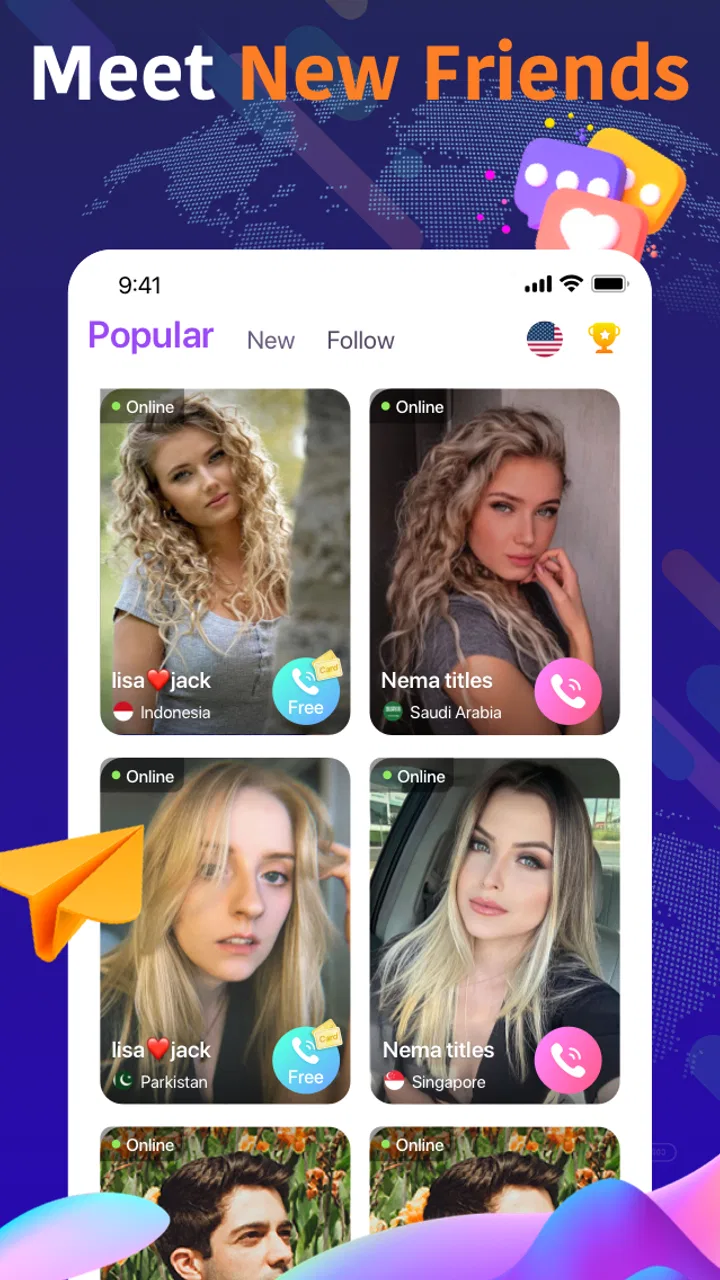
Olamet - Video Chat Online is a social communication app designed for meeting and chatting with people through video calls and online conversations. After creating or accessing an account, users can browse available profiles or matching options and start interacting through supported chat features. The exact experience may vary by region, device, account status, and the app version installed.
02Is Olamet - Video Chat Online free to download and use?
The application may be available to download at no initial cost, but some communication features, virtual items, premium options, or extended interactions can require in-app purchases. Before using paid functions, review the pricing shown inside the app and check whether subscriptions renew automatically. Availability of free credits, promotions, and payment requirements may differ depending on your country and platform.
03Is Olamet safe for meeting and video chatting with strangers?
As with any social video-chat platform, users should be careful when interacting with people they do not know. Avoid sharing your address, passwords, financial details, private documents, or other sensitive information. Use blocking and reporting tools when available, and end conversations that make you uncomfortable. Parents should also consider whether the app is appropriate for younger users and review its age rating.
04Does Olamet require a camera, microphone, or personal information?
Video conversations normally require access to your device’s camera and microphone, while text-based features may work without enabling both permissions. The app may also request account or profile information to provide matching, messaging, security, and personalization features. Grant only permissions that seem necessary, and review the privacy policy and your device settings before creating a profile or starting a call.
05What should I do if I experience inappropriate content, harassment, or technical problems?
If another user behaves inappropriately, stop communicating and use the in-app reporting or blocking options, if provided. Do not respond with personal information or send money to someone you have met online. For connection, login, camera, microphone, or payment problems, update the app, check your internet connection and permissions, then contact the developer through the official support channel listed on the app store.
Pros
- Simple interface makes it easy to start video chats quickly.
- Supports meeting new people from different countries and cultures.
- Real-time video interaction feels more personal than text-only messaging.
- Useful discovery features help you find potential chat partners.
- Available on mobile devices for convenient conversations on the go.
Cons
- The quality of conversations can vary significantly between users.
- Some features may require in-app purchases or virtual credits.
- Video calls can consume substantial mobile data and battery power.
- Public chat environments may expose users to inappropriate behavior.
- A stable internet connection is essential for smooth
- uninterrupted calls.

Olamet - Video Chat Online
Gallery